

Let’s be real for a second. Managing your own money can feel like trying to navigate a maze blindfolded. You’ve got news headlines screaming about inflation, Reddit threads hyping random tickers, and your cousin’s “guaranteed” crypto tip. It’s noise. Pure noise. But here’s the thing — you don’t need a Bloomberg terminal or a Wall Street analyst to cut through it. You just need a system. That’s where quantitative factor investing comes in. And honestly, you can do it all with free tools and a little bit of patience.
What Is Quantitative Factor Investing, Anyway?
Think of it like this: instead of picking stocks based on gut feelings or a hot tip, you’re using cold, hard data. Factors are specific characteristics — like low volatility, value, or momentum — that historically have predicted better returns. You’re not betting on one stock; you’re building a basket of stocks that share a winning trait. It’s like fishing with a net instead of a single hook. Sure, you might miss the one monster fish, but you’ll catch a lot more dinner.
Quantitative factor investing takes that idea and runs it through a spreadsheet. You screen for stocks that score high on your chosen factors, rank them, and build a portfolio. No emotion. No FOMO. Just math. And the best part? You don’t need a PhD in finance to do it.
The Core Factors You Should Know
There are dozens of factors out there, but let’s stick with the big ones. These are the heavy hitters that academic research keeps coming back to:
- Value — Stocks trading at a discount relative to fundamentals (think low P/E, low P/B).
- Momentum — Stocks that have been rising in price over the last 6–12 months. Trend is your friend, until it isn’t.
- Quality — Companies with strong profitability, stable earnings, and low debt. The boring stuff that works.
- Low Volatility — Stocks that don’t swing around like a caffeinated squirrel. Less drama, often better risk-adjusted returns.
- Size — Small-cap stocks tend to outperform large-caps over long periods. But they come with more bumps.
You don’t have to use all of them. In fact, mixing two or three factors is often enough to get decent diversification. I personally like pairing value with momentum — it’s like having a sensible anchor and a sail that catches the wind.
Free Screeners That Actually Work
Now, the tools. You don’t need to pay for Finviz Elite or some expensive subscription. Here are three free screeners that’ll get the job done — and I use them myself.
1. Finviz (Free Version)
Finviz is the Swiss Army knife of stock screeners. The free version gives you access to over 60 filters. You can screen for P/E ratios, relative strength, market cap, and even insider transactions. It’s fast, it’s visual, and it exports to CSV. The only downside? You’re limited to basic charts. But for factor screening, it’s a beast.
2. Portfolio Visualizer
This one’s less for screening and more for backtesting. But honestly, it’s essential. You can test how your factor-based portfolio would have performed over the last decade. It’s a reality check. You might think a high-momentum strategy is genius until you see it crash in 2022. Portfolio Visualizer humbles you — and that’s a good thing.
3. Yahoo Finance (Custom Screener)
Yahoo’s screener is clunky, I’ll admit. But it’s free and it pulls data from the same source as many paid tools. You can filter by dividend yield, beta, earnings growth — all the factor stuff. It’s not pretty, but it works. I use it when I want to double-check Finviz results.
Building Your First Factor Screen — A Step-by-Step Example
Let’s walk through a real example. Say you want to build a value + momentum portfolio. Here’s how you’d do it on Finviz:
- Go to Finviz.com and click on “Screener.”
- Set the market cap filter to “Over $2 billion” (to avoid penny stock chaos).
- Add a P/E ratio filter: “Under 15” (value factor).
- Add a Price/Book filter: “Under 1.5” (another value metric).
- Now for momentum: add the “Performance (Quarter)” filter and set it to “Up 10% or more.”
- Also add “Performance (Year)” and set it to “Up 20% or more.”
- Click “Run” and see what pops up.
You’ll probably get a list of 20–50 stocks. From there, you can sort by market cap or sector to avoid overconcentration. Export the list, do a quick sanity check on each stock’s debt levels, and you’ve got a portfolio. No magic. No hype. Just numbers.
Where to Get Free Data for Deeper Analysis
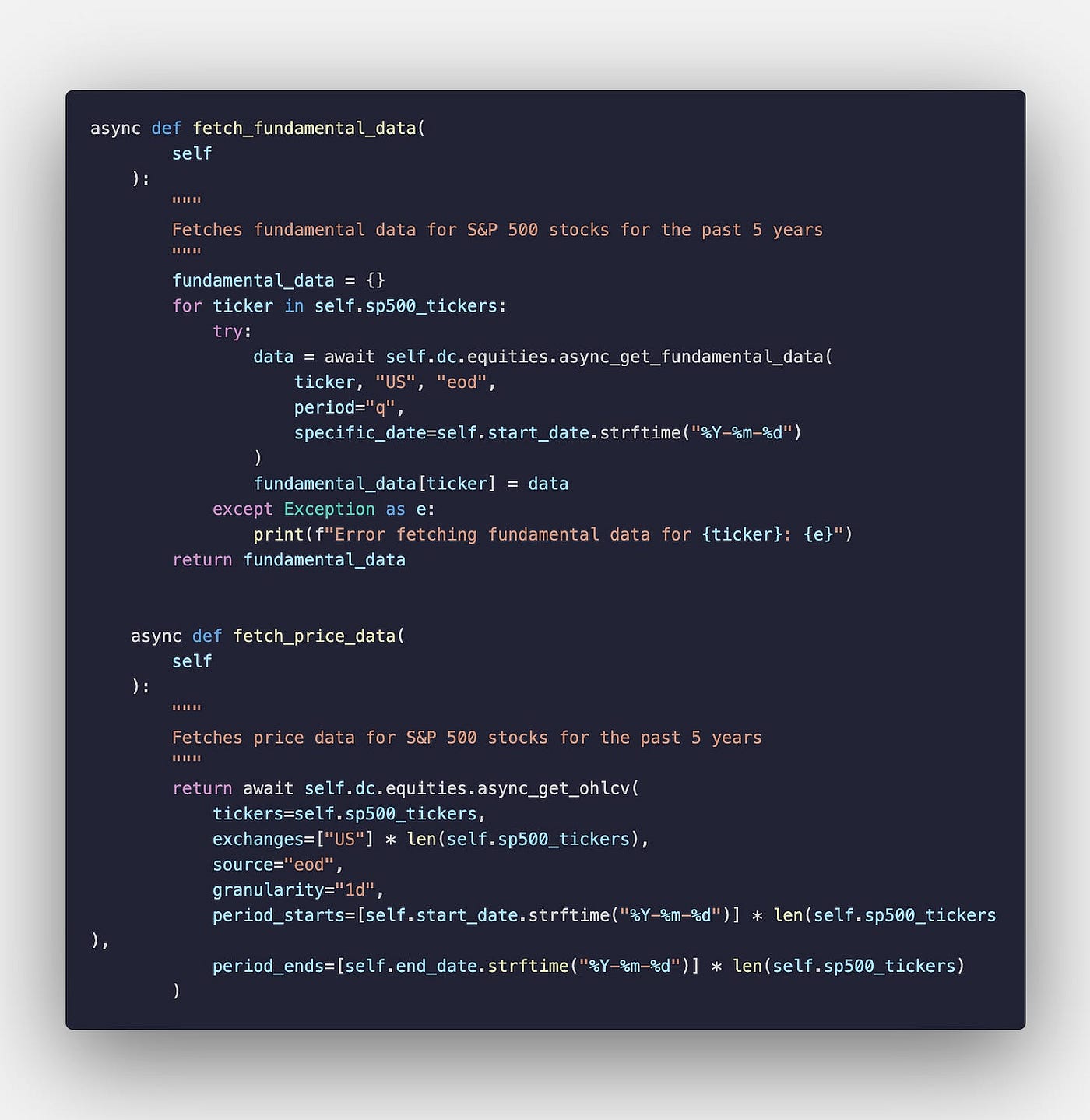
Screeners give you the first cut. But if you want to dig deeper — maybe calculate your own factor scores or backtest custom rules — you’ll need raw data. Here are some free sources:
| Source | What It Offers | Best For |
|---|---|---|
| Alpha Vantage | Free API for historical prices and fundamentals | Building custom scripts in Python or Excel |
| Quandl (via Nasdaq) | Free tier with some financial data sets | Academic-style factor research |
| Simfin | Clean, normalized financial statements | Quality factor calculations (ROE, debt ratios) |
| Yahoo Finance (download CSV) | Historical price data for any ticker | Quick momentum or volatility checks |
I’ll be honest — pulling data from APIs can feel intimidating at first. But even if you just use Excel’s “From Web” feature to grab a CSV from Yahoo, you’re already ahead of most retail investors. Start small. You can always scale up.
Common Pitfalls (And How to Dodge Them)
Factor investing isn’t foolproof. In fact, it has some nasty traps. Here’s what I’ve learned the hard way:
- Data mining bias — Just because a factor worked in the past doesn’t mean it will in the future. Don’t over-optimize. Keep it simple.
- Survivorship bias — Free screeners only show stocks that still exist. They ignore the ones that went bankrupt. That skews your backtest results. Always account for this.
- Factor crowding — If everyone piles into the same factor (like low volatility in 2020), it stops working. Be willing to rotate or diversify factors.
- Re-balancing too often — Checking your portfolio daily is a recipe for anxiety and transaction costs. Monthly or quarterly is plenty.
One more thing — don’t ignore the macro context. A value factor might suck during a tech bubble, but shine in a recession. Know what regime you’re in. It’s not timing the market; it’s respecting the weather.
Putting It All Together — A Simple Workflow
Alright, let’s tie this into a practical routine. Here’s my weekly workflow, and it takes maybe 30 minutes:
- Sunday evening: Run a multi-factor screen on Finviz. Export the top 30 stocks.
- Monday morning: Cross-check each stock’s debt-to-equity and earnings stability using Simfin or Yahoo.
- Monday afternoon: Rank the stocks by a combined factor score (I use a simple average of value and momentum percentiles).
- Tuesday: Buy the top 10–15 stocks in equal weights. Set a reminder to rebalance in 3 months.
- Once a month: Run a Portfolio Visualizer backtest to see if your factor combo is still beating the market.
That’s it. No day trading. No CNBC. Just a systematic approach that lets you sleep at night. Sure, you’ll underperform during crazy bull runs, but you’ll also avoid the 50% drawdowns that wipe out emotional traders.
The Quiet Power of Being Systematic
Here’s the thing nobody tells you about self-directed investing — it’s not about being the smartest person in the room. It’s about being disciplined. Factor investing forces that discipline. You’re not chasing stories; you’re following signals. And when your portfolio drops 10% in a month (it will), you don’t panic. You check your factors. If they’re still intact, you hold. If they’re broken, you adjust. No drama.
The free tools I mentioned — Finviz, Portfolio Visualizer, Yahoo, Simfin — they’re not perfect. But they’re enough. Enough to build a portfolio that’s backed by decades of academic research. Enough to stop guessing and start knowing. And honestly, that’s a rare edge in a world of noise.
So go ahead. Open a screener. Pick two factors. Run the numbers. See what happens. The market doesn’t care about your opinion — but it respects a system.